

THE MILITARY HUMILIATION THAT SHOOK ADDIS ABABA
When Prime Minister Abiy Ahmed launched the war on Tigray in November 2020, he promised a swift “law enforcement operation.” His military leaders boasted the conflict would end “within less than 10 to 15 days” . Instead, what unfolded was one of the most stunning military humiliations in modern Ethiopian history—a defeat that exposed the fundamental weakness of the federal army and shattered the myth of Abiy’s invincibility.
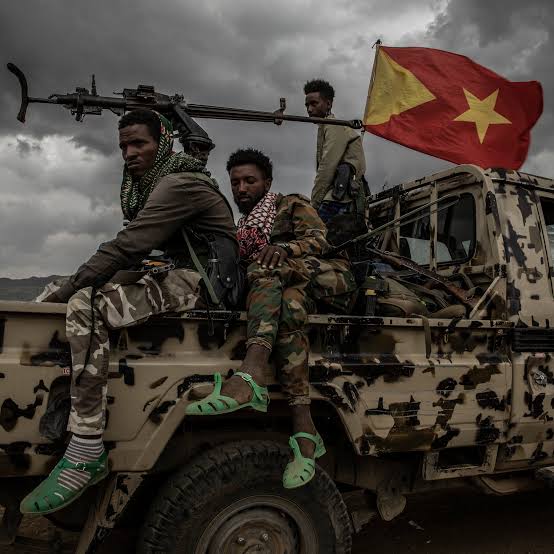
For over two years, the Tigray Defense Forces (TDF)—a regional force that military sources estimate grew to over 200,000 fighters, with some reports suggesting double that number —not only held off the Ethiopian National Defense Force but repeatedly routed it. They destroyed entire divisions, inflicted thousands of casualties, and occupied strategic towns across Amhara and Afar regions . A military source in Addis Ababa reckons the federal soldiers and regional militia could have lost up to half their force strength of some 400,000 personnel during the conflict’s peak .
The war of attrition by December 2021 had produced a “mutually hurting stalemate”—neither side could achieve decisive victory . But for Abiy, who had declared victory multiple times, the reality that Tigrayan forces had marched to within striking distance of Addis Ababa was a humiliation from which his regime has never fully recovered .
HOW THE TIGRAY DEFENSE FORCES OUTMANEUVERED THE FEDERAL ARMY
The TDF’s military success was not accidental. It stemmed from a combination of tactical superiority, intimate knowledge of terrain, and strategic cohesion that the federal forces could not match.
The Terrain Advantage: According to military analysis from the time of the war, the TDF consistently occupied the “high ground” in the mountainous terrain of northern Ethiopia, from which they could shell federal forces in the valleys at will, inflicting heavy casualties . This tactical advantage was so devastating that at a three-day emergency meeting in October 2021, ENDF General Abebaw Tadese admitted to top commanders that the main obstacle to their advance was the terrain itself .
Strategic Intelligence Failures: The federal government’s intelligence apparatus failed repeatedly. The TDF successfully coordinated with the Oromo Liberation Army (OLA), opening a new front against the federal government in the south, and reportedly coordinated attacks between Tigrayan and Oromo forces . This strategic coordination, combined with the federal government’s inability to secure supply lines, exposed the ENDF’s operational weaknesses.
THE PRETORIA AGREEMENT: PEACE ON PAPER, WAR BY OTHER MEANS
The November 2022 Pretoria Peace Agreement was signed not because Abiy had achieved military victory, but because the war had become strategically unsustainable . Prime Minister Abiy himself has repeatedly described it as an “extraordinary peace initiative” after “military success”—a framing that bears little relation to the battlefield reality .
The peace, however, has proven fragile. As one analyst put it, the current state of “no war no peace” in northern Ethiopia seems to be preserved only by “the rainy season’s predictable afternoon showers” . By early 2026, clashes had resumed along the Tigray-Afar border, and the federal government conducted drone strikes in central Tigray in January 2026, prompting the TDF leader to warn that Abiy had started “something resembling an all-out war” .
WHY ABIY CONTINUES TO BLUNDER: THE PATTERN OF MISSTEPS
Abiy’s post-war strategy reveals a consistent pattern of blunders that make renewed conflict more likely, not less.
Banning the TPLF: In May 2025, the National Election Board of Ethiopia revoked the TPLF’s status as a political party . The TPLF responded by stating that “denying our legal recognition undermines the very foundation of the peace accord” . This action has effectively pushed the TPLF out of Ethiopia’s political process, leaving it with no incentive to maintain peace.
Cultivating Proxies: The federal government has reportedly supported the emergence of the Tigray Peace Forces (TPF), a militia populated by defectors from the TDF . Well-connected Tigrayans stated that the Ethiopian government is responsible for paying the monthly salaries of TPF fighters—reportedly north of 6,000 birr per month . The leaders of the TPF have denied this, but the perception persists that Abiy is using proxies to destabilize the region from within.
Rejecting Dialogue: Abiy has consistently refused to engage in meaningful dialogue with the TPLF leadership, insisting instead that dialogue with the current leadership is “impossible” . His own military and political leadership, meanwhile, has been weakened by defections and the loss of key allies. The relationship with Eritrea, once a wartime ally, has deteriorated so badly that Eritrea and the TPLF have reportedly established an informal tactical alliance—what analysts call “Tsimdo” (alignment) .
WHY NOT WORKING WITH THE TPLF WILL BLUNDER THE GOVERNMENT FURTHER
The fundamental miscalculation at the heart of Abiy’s approach is the assumption that the TPLF can be destroyed or marginalized into irrelevance. The evidence suggests otherwise.
The TPLF Remains a Military Force: Despite the peace agreement, the TDF has maintained significant fighting capabilities. Reports indicate that while the TDF has initiated demobilization, it has retained its capacity to fight . As one young Tigrayan put it, the TDF acts as a “militia of the party” .
No Political Alternative in Tigray: The federal government’s attempt to create a puppet administration in Tigray has failed. The TPLF remains the dominant political force in the region, with deep roots in the population . Tigrayans across the political spectrum view the federal government’s actions—including the blockade, the drone strikes, and the proxy militias—as existential threats .
Proxy Strategy Backfires: The creation of the TPF and the cultivation of anti-TPLF Tigrayan factions has not unified the region behind Abiy. Instead, it has created internal fragmentation that increases the risk of civil conflict . The defection of former TPLF commanders to the federal side—figures like General Gebregziabher Beyene and General Teklay Ashebir—has been seen by many Tigrayans as “betrayal” rather than political legitimacy .
International Isolation: The international community has grown increasingly alarmed at the prospect of renewed war. In early 2026, the UN High Commissioner for Human Rights warned that “the situation remains highly volatile, and we fear it will further deteriorate” . Médecins Sans Frontières also published a report concluding that Ethiopian troops “executed” three of its employees in 2021, further embarrassing the Abiy administration . The erosion of international goodwill—once Abiy’s greatest asset—continues apace.
The Regional Dimension: The tensions with Eritrea over Red Sea access, the deteriorating relationship with the Amhara Fano militia (now turning against Abiy), and the growing instability in Sudan all create a regional environment where renewed Tigray conflict could spiral into a wider war . Abiy’s parliamentary warning that “war can start at any time” was not merely rhetorical; it was a strategic signal of intent that has alarmed regional actors .
CONCLUSION: THE COST OF REFUSAL
Abiy Ahmed’s refusal to work with the TPLF is not principled opposition to a political adversary; it is a blunder that continues to compound the instability of his own regime.
The military humiliation of the federal army by the Tigray Defense Forces exposed the fundamental weakness at the core of Abiy’s project: a centralized state that cannot defeat a determined regional force that enjoys popular support. Every post-war action—banning the TPLF, arming proxies, refusing dialogue—has only deepened the conflict dynamics that produced the war in the first place.
As peace expert William Zartman observed, parties resolve conflicts only when they are ready to do so—when the costs of continued fighting outweigh the benefits . Ethiopia reached that moment in 2022. Waiting for another devastating war to create those conditions again would be a catastrophic failure.
The pretence that Ethiopia can be stabilized without engaging its most significant regional political force is not merely unrealistic; it is a formula for continued instability. Abiy’s stubborn refusal to negotiate is not strength; it is a blunder that risks another devastating war that Ethiopia cannot afford.
The question is no longer whether the TPLF should be part of Ethiopia’s future. The question is whether Abiy will continue to make the same mistake until the country is consumed by the fire he has stoked.


Leave a Reply