
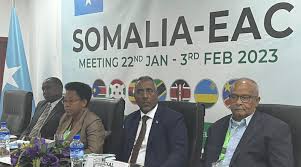
Ladies and gentlemen, today we examine one of the most fascinating and often underestimated economic stories in Africa—the story of the Somali community and its remarkable influence on the economic landscape of the Horn of Africa.
When discussing economic power in the Horn of Africa, many people focus on governments, foreign investors, ports, or multinational corporations. Yet, beneath these formal structures exists another powerful force: the Somali people themselves.
The Somali community has become one of the most influential economic actors in the Horn of Africa, not merely because of political power or natural resources, but because of an entrepreneurial culture deeply rooted in history, resilience, mobility, and social trust.
To understand the Somali economic phenomenon, we must first ask a philosophical question:
What makes an economy strong?
Is it the government?
Is it natural resources?
Or is it the ability of ordinary people to create wealth under difficult circumstances?
The Somali story suggests that the true foundation of economic development is human agency—the ability of people to organize, trade, adapt, and build networks regardless of adversity.
For centuries, Somalis have been traders, merchants, livestock exporters, sailors, and entrepreneurs. Their geographical location along the Indian Ocean and the Gulf of Aden placed them at the crossroads of Africa, the Middle East, and Asia.
Long before modern states existed, Somali merchants traded with civilizations in Arabia, Persia, India, and East Africa. Their commercial traditions became embedded in the culture itself.
Trade was not simply an economic activity.
It became an identity.
Even during periods of state collapse, civil war, and political instability, Somali communities demonstrated a remarkable ability to create economic systems outside formal state structures.
This is perhaps one of the greatest economic lessons of our time.
The absence of a strong state did not eliminate economic activity.
Instead, communities developed informal financial systems, trust-based business relationships, and transnational networks that connected cities across continents.
Today, Somali entrepreneurs can be found in:
Kenya,
Ethiopia,
Djibouti,
Somalia,
Uganda,
South Africa,
the Gulf States,
Europe,
North America,
and Asia.
Their investments have created jobs, built markets, and facilitated cross-border trade throughout the Horn of Africa.
Take for example the Eastleigh area in Nairobi.
What was once an ordinary residential area has transformed into one of East Africa’s largest commercial centres.
Thousands of traders import goods from China, Turkey, Dubai, and India.
Billions of shillings circulate through this marketplace annually.
The economic activities of Somali traders have transformed not only Eastleigh but also supply chains extending into Uganda, South Sudan, Rwanda, Tanzania, and the Democratic Republic of Congo.
Similarly, in Ethiopia, Somali business communities play a critical role in livestock exports and cross-border trade.
In Djibouti, Somali merchants have helped shape logistics, transportation, and import-export industries that serve millions across the region.
Within Somalia itself, cities such as Mogadishu, Bosaso, and Hargeisa have experienced significant private sector growth driven largely by Somali entrepreneurship.
One may ask:
How did this happen?
The answer lies partly in philosophy.
The Somali economic model demonstrates the importance of social capital.
Social capital refers to trust, relationships, community bonds, and networks that facilitate cooperation.
In many cases, Somali businesses operate on systems of trust that sometimes function even without extensive written contracts.
Families pool resources.
Communities support investments.
Diaspora members finance projects back home.
Information moves quickly through kinship networks.
These systems have allowed Somali communities to mobilize capital with remarkable speed.
The philosopher Aristotle once argued that humans are political animals who thrive through association and community.
The Somali experience appears to support this idea.
Economic success often emerges not simply from institutions but from the relationships between people.
The Somali community has mastered the art of economic association.
Another important element is the Somali diaspora.
According to international development studies, remittances from the Somali diaspora have long represented one of the largest sources of financial inflows into Somalia.
These funds support:
education,
healthcare,
business creation,
construction,
and household consumption.
In many parts of the Horn of Africa, Somali-owned businesses have become major employers.
Their investments have contributed to urban development and regional integration.
But the story becomes even more interesting when viewed through constitutional and legal lenses.
Modern constitutions generally protect economic freedoms.
The Constitution of Kenya guarantees rights relating to property, equality, freedom from discrimination, and the freedom to engage in lawful economic activities.
Similarly, constitutional principles throughout the region increasingly recognize economic participation as an essential component of human dignity.
The philosopher John Locke argued that property rights are extensions of human liberty.
When individuals have the ability to own property, trade, and accumulate wealth through lawful means, they exercise a fundamental aspect of freedom.
The Somali entrepreneurial experience illustrates this principle.
Economic participation becomes an expression of human liberty.
International law also offers important perspectives.
The Universal Declaration of Human Rights recognizes the right to own property and the right to work.
The International Covenant on Economic, Social and Cultural Rights emphasizes the right of everyone to gain a living by work freely chosen.
The African Charter on Human and Peoples’ Rights similarly protects property rights and promotes economic and social development.
These principles are particularly important in regions characterized by migration and cross-border communities.
The Somali people do not exist only within the borders of one state.
They are present across several countries in the Horn of Africa.
Their economic activities transcend borders.
This raises important philosophical questions about citizenship, identity, and economic belonging.
Can economic communities exist beyond political boundaries?
Can trade become a force that unites societies more effectively than politics?
The Somali experience suggests that the answer may be yes.
Trade creates interdependence.
Interdependence reduces isolation.
Isolation often produces conflict.
Commerce, on the other hand, encourages cooperation.
The philosopher Montesquieu once observed that commerce softens manners and promotes peace because trading societies become dependent on one another.
Across the Horn of Africa, Somali traders have created networks that connect communities that might otherwise remain economically isolated.
Livestock moves across borders.
Consumer goods move through ports.
Transportation networks expand.
Financial services develop.
Employment opportunities emerge.
In this sense, the Somali business community has become an engine of regional integration.
Yet challenges remain.
Somali communities often face stereotypes, discrimination, and suspicion.
Cross-border traders are sometimes viewed through security lenses rather than economic lenses.
Restrictions on movement, financial regulations, and political tensions occasionally affect business operations.
This is where constitutionalism and international law become essential.
The rule of law requires that individuals be judged according to their conduct, not their ethnicity or origin.
Equality before the law is a cornerstone of constitutional democracy.
International human rights principles reject discrimination and support equal economic opportunities.
Economic participation should not be constrained by prejudice.
The Somali economic story is also a lesson in resilience.
Resilience is the ability to adapt and recover from adversity.
Despite decades of instability, Somali communities have built telecommunications companies, airlines, financial systems, educational institutions, and major trading enterprises.
This challenges conventional assumptions about development.
Development is often portrayed as a product of state institutions alone.
But the Somali case demonstrates that societies possess enormous capacities for self-organization.
Human beings can create order, markets, and prosperity even under difficult circumstances.
Perhaps this is the greatest philosophical lesson of all.
The wealth of nations does not ultimately reside in minerals, oil, or geography.
It resides in people.
It resides in trust.
It resides in networks.
It resides in entrepreneurship.
The Somali community has shown that commerce can survive adversity, that trade can transcend borders, and that human ingenuity can build prosperity even in the absence of perfect political conditions.
As the Horn of Africa enters a new era characterized by infrastructure projects, regional integration, and expanding maritime opportunities, the role of Somali entrepreneurs is likely to become even more significant.
Their investments in logistics, trade, technology, real estate, and the blue economy could shape the future of the entire region.
The story of the Somali community is therefore not merely a Somali story.
It is an African story.
It is a human story.
It is a story about the extraordinary capacity of ordinary people to create economic value through determination, cooperation, and vision.
And perhaps, above all, it is a reminder that constitutions, international law, and governments ultimately exist to protect human dignity and create environments where people can pursue their aspirations peacefully and productively.
Because when communities are free to trade, free to innovate, and free to cooperate, economies grow.
And when economies grow through inclusion and respect for human rights, peace and prosperity become possible.
The Somali community is not simply participating in the economic transformation of the Horn of Africa.
It is helping to shape its future.



Leave a Reply