
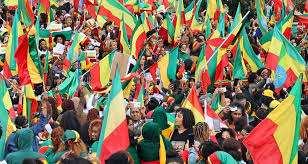
Today, we examine one of the most important questions facing Ethiopia—not only today, but for decades to come:
What role should Ethiopian youths play in shaping Ethiopia’s political future?
This is a conversation that goes beyond elections, political parties, or personalities. It is about the generation that will inherit one of Africa’s oldest civilizations, one of its fastest-growing economies, and one of its most complex political systems.
Ethiopia is a country of over 130 million people, and more than half of its population is under the age of thirty. That means the future of Ethiopia will largely be determined not by today’s political elites but by today’s young people.
The question, therefore, is not whether Ethiopian youths will shape the country’s future.
The question is how they will shape it.
Will they become agents of national unity or instruments of political division?
Will they build institutions or simply inherit political conflicts?
Will they focus on personalities, or will they strengthen principles?
These are the questions that deserve serious reflection.
Ethiopia’s Constitutional Framework
Every discussion about Ethiopia’s political future should begin with the country’s Constitution.
The Constitution of the Federal Democratic Republic of Ethiopia establishes Ethiopia as a federal democratic republic founded upon constitutional governance, the rule of law, respect for human rights, and the sovereignty of the people.
The Constitution also recognizes Ethiopia as a federation composed of regional states while affirming the rights of citizens and the responsibilities of government institutions.
Whether one agrees or disagrees with aspects of the constitutional framework, one principle remains clear:
Political change should occur through constitutional means rather than violence.
Constitutions are designed to provide peaceful mechanisms for resolving disagreements.
Political disagreements are normal in every democracy.
What matters is whether those disagreements are resolved through institutions instead of conflict.
Young Ethiopians therefore have an important responsibility to understand the Constitution—not simply to quote it during political debates, but to understand how institutions function, how laws are made, and how citizens participate in governance.
An informed citizen strengthens democracy.
An uninformed citizen can unintentionally weaken it.
International Law and Democratic Participation
International law also provides useful guidance.
The Universal Declaration of Human Rights recognizes the right of every individual to participate in the government of their country.
The International Covenant on Civil and Political Rights protects freedoms such as expression, peaceful assembly, association, and political participation.
Similarly, the African Charter on Human and Peoples’ Rights encourages participation in public affairs while emphasizing respect for peace, human dignity, and the rule of law.
These international principles are not designed to replace national constitutions.
Rather, they complement constitutional governance by encouraging governments and citizens alike to respect rights while maintaining public order and stability.
Youth participation therefore is not simply a political choice.
It is recognized internationally as an important pillar of democratic development.
Moving Beyond Traditional Political Norms
For many years, politics across Africa—including Ethiopia—has often revolved around personalities.
People sometimes become loyal to individuals more than institutions.
Political debates often become emotional rather than evidence-based.
Social media has amplified this trend.
Young people can change this.
Instead of asking:
“Who should we support?”
perhaps the better question is:
“What policies create better lives?”
Instead of asking:
“Which politician is stronger?”
perhaps ask:
“Which institutions are becoming stronger?”
Instead of debating individuals endlessly, young people should debate ideas.
Because personalities eventually leave office.
Institutions remain.
Countries become prosperous not because of permanent leaders, but because of strong institutions that continue functioning regardless of who occupies political office.
Critical Thinking Instead of Political Tribalism
Critical thinking may be one of the greatest contributions Ethiopian youths can make.
Critical thinking means evaluating information carefully before accepting it as truth.
It means questioning misinformation regardless of where it originates.
It means avoiding emotional reactions without evidence.
Today’s digital world produces enormous amounts of information.
Unfortunately, it also produces enormous amounts of misinformation.
Young people must develop the discipline to verify sources before sharing news.
One false story can inflame communities.
One misleading video can increase tensions.
Responsible digital citizenship has become part of responsible political participation.
Instead of becoming consumers of propaganda, Ethiopian youths should become producers of informed public dialogue.
Civic Education Should Become a National Priority
Politics is more than campaigning.
It includes understanding public finance.
Understanding local government.
Understanding the judiciary.
Understanding public policy.
Understanding constitutional rights.
Many democracies invest heavily in civic education because informed citizens make better political decisions.
Young Ethiopians should seek knowledge beyond political slogans.
They should understand how budgets are allocated.
How Parliament functions.
How courts operate.
How elections are organized.
How public accountability works.
Knowledge creates responsible citizenship.
Economic Participation is Political Participation
One misconception is that politics only happens inside Parliament.
That is not true.
Every entrepreneur contributes to national development.
Every innovator contributes to national development.
Every scientist contributes to national development.
Every teacher contributes to national development.
Economic participation strengthens political stability.
Countries with expanding economic opportunities often create stronger foundations for social cohesion.
Young Ethiopians should therefore not limit political engagement to rallies and online debates.
Building businesses.
Creating jobs.
Developing technology.
Improving agriculture.
Supporting innovation.
These are also forms of nation-building.
Economic resilience strengthens democratic resilience.
National Identity Alongside Diversity
Ethiopia is home to many languages, cultures, religions, and ethnic communities.
This diversity represents both an opportunity and a responsibility.
The Constitution recognizes the country’s federal structure and cultural diversity.
At the same time, successful states often encourage citizens to appreciate both their local identities and their shared national identity.
Young people can promote dialogue that respects diversity while also recognizing common national interests.
Differences need not become divisions.
Constructive political participation requires listening as much as speaking.
Leadership Beyond Elections
Many people associate leadership with holding political office.
Yet leadership begins long before elections.
A community volunteer demonstrates leadership.
A researcher develops leadership through innovation.
A journalist strengthens democracy through responsible reporting.
A student leader practices leadership through service.
Young Ethiopians should redefine leadership as service rather than status.
The world’s most respected leaders often earned public trust through years of community contribution before entering government.
Technology and Responsible Citizenship
Technology is transforming political participation worldwide.
Artificial intelligence.
Digital media.
Data analysis.
Online education.
Digital entrepreneurship.
These tools allow young people to influence policy discussions more effectively than previous generations.
However, technology should promote informed participation rather than online hostility.
Digital platforms should become spaces for respectful debate, evidence-based discussion, and constructive engagement.
Democracy benefits when technology expands understanding instead of polarization.
Accountability Should Apply to Everyone
Healthy democracies depend on accountability.
Citizens should expect transparency from public institutions.
Governments should communicate openly.
Public officials should remain accountable under the law.
Likewise, citizens also carry responsibilities.
Political participation should remain peaceful.
Public dialogue should respect differing opinions.
Disagreements should be resolved through lawful and democratic processes.
Accountability is strongest when it applies fairly to everyone.
Looking Beyond Immediate Politics
Many political debates focus only on today’s headlines.
Young people should think twenty or thirty years ahead.
How will climate change affect Ethiopia?
How can education become more competitive globally?
How should technology transform public services?
How can agriculture become more productive?
How can Ethiopia create more employment opportunities?
How can the country strengthen regional trade?
These strategic questions often have greater long-term impact than daily political controversies.
Nations progress when leaders—and citizens—plan beyond electoral cycles.
Building a Culture of Dialogue
No democracy can succeed without dialogue.
Dialogue requires patience.
Listening.
Respect.
Compromise.
Every society contains different political opinions.
That diversity should become a source of better policymaking rather than conflict.
Young Ethiopians have the opportunity to create a political culture where disagreement is normal but hostility is not.
Strong democracies encourage vigorous debate while preserving mutual respect.
Conclusion
Ultimately, Ethiopia’s political future will not be determined solely by governments, opposition parties, or elections.
It will be shaped by millions of ordinary young Ethiopians making everyday decisions.
Choosing facts over misinformation.
Choosing dialogue over hostility.
Choosing institutions over personalities.
Choosing constitutional participation over violence.
Choosing national development over short-term political gains.
The Constitution provides the legal framework.
International human rights principles encourage participation, dignity, and peaceful engagement.
But the character of Ethiopia’s democracy will depend largely on how its young citizens choose to exercise those rights and responsibilities.
If Ethiopian youths embrace education, critical thinking, entrepreneurship, civic responsibility, constitutionalism, and constructive dialogue, they will contribute not only to political stability but also to sustainable national development.
The future of Ethiopia is not something waiting to happen.
It is something being built every single day by the choices its young people make.


Leave a Reply